The Best Restaurants In New Orleans, And More
Arnaud's French 75 Bar Grows In Deliciousness
The revival of interest in drinking cocktails continues to bring us new pleasures. The best bars around town are not only making superior cocktails, but serving more interesting bar food. Indeed. it's become possible to take an entire meal in the bar. I must say I like the change of pace from a standard dinner. Arnaud's sports not only an historic, very cool antique bar, but also one of the city's top mixologists: Chris Hannah. He's one of the few people I trust enough for this order: "Just make me something."
Meanwhile, Chef Tommy DiGiovanni is back there with his new bar menu. This stuff is really good, especially the shrimp and the pompano. And few nibbles go as well with a cocktail as soufflee potatoes.
House-made charcuterie $9.50
Pate de campagne and hogshead cheese
Chef's Cheese Selection $16.50
Crawfish Spring Roll $8.75
Rolled in rice paper with rice stick noodles, cilantro and lettuce, with peanut sauce
Smoked Pompano $5.75
Hickory smoked (in house) fresh pompano with sour cream, capers and onion, served on toast points
Brie and Jalapeno-Stuffed Shrimp $7.50
Oysters en Brochette $9.26
Wrapped with bacon, fried, and served with marchand de vin sauce
Gougeres $4.75
Gruyere cheese puffs
Soufflee Potatoes $8.95
![]()
![]()
![]()
Arnaud's. French Quarter: 813 Bienville, 504-523-5433.
![]()
Tujague's Throws A Big Feast To Help Shuckers
Steve Latter--the owner of the venerable French Market dining fixture Tujague's--figured he had to do something for the oyster shuckers. The large staff of P&J Oyster Company was laid off a month ago when the BP oil spill forced the closing of most of the oyster beds where P&J gets it bivalves. P&J and Tujague's have both been feeding New Orleans people since the 1800s, and have a long relationship.
Thursday, September 16, Tujague's will fill all its rooms for a dinner the likes of which I don't remember ever having been served in that establishment. Steve Latter rounded up donations from other local food providers to make the evening a memorable one. The price is $125 per person, inclusive of tax, tip, and wines throughout the dinner. The entire amount will go to the out-of-work P&J oyster shucking team and their families. Here's the menu:
Hors d'Oeuvres
Blackened shrimp with mango and cucumber
Grilled lamb chops with roasted corn cake, Worcestershire glaze
Lobster egg rolls with Asian dipping sauce
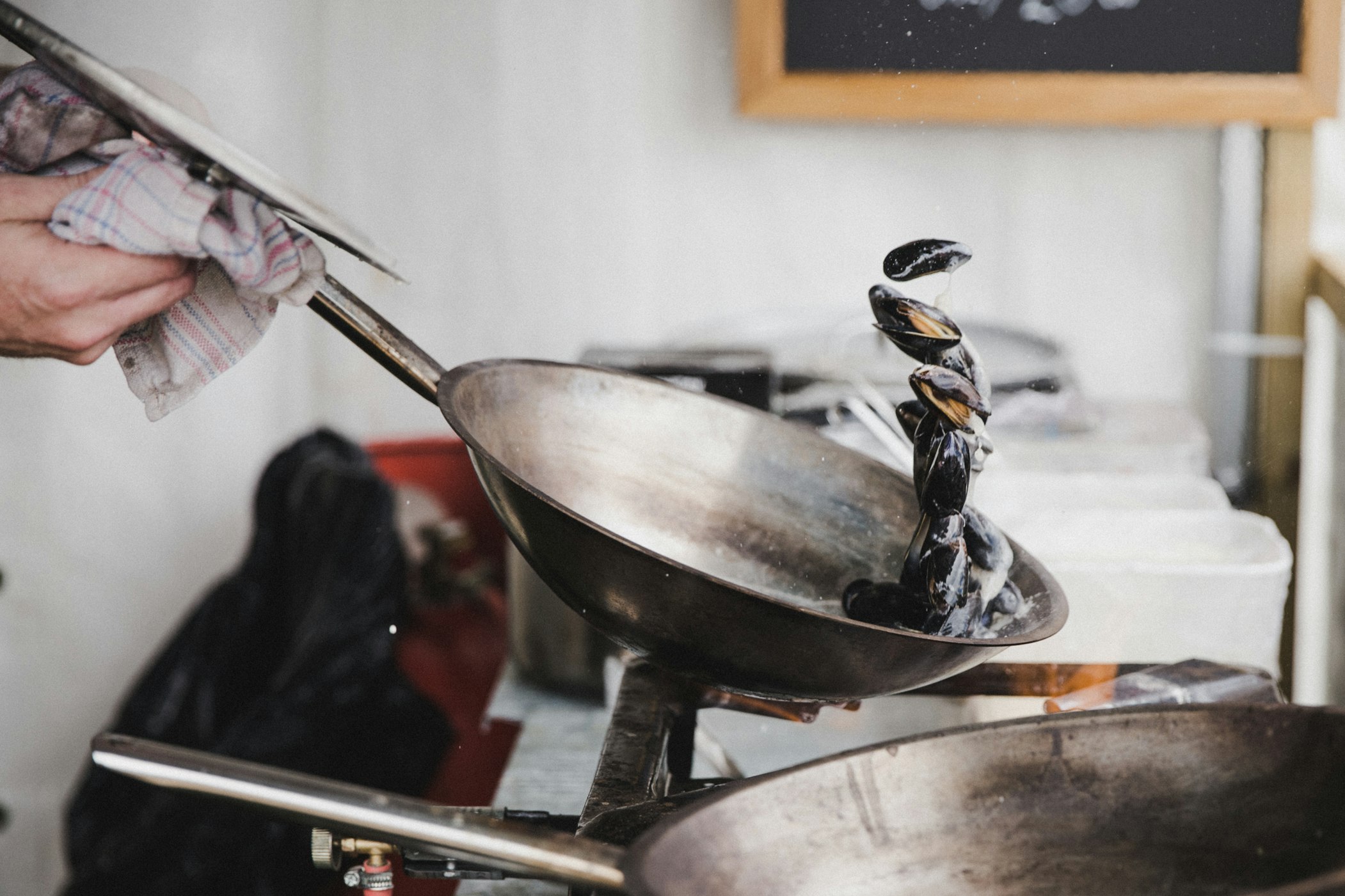
Steamed Mussels And Foie Gras
Garlic crostini
Mixed Green Salad
Fried Vidalia onions, toasted pumpkin seeds, warm bacon vinaigrette
Filet Mignon
Stuffed with sun dried tomato and goat cheese, with oven roasted potatoes, mushroom bordelaise
~or~
Potato Encrusted Drum
Curry tomato broth, avocado creme friache
White Chocolate Cheesecake
Fresh raspberry coulis
"They are an integral part of our food culture and desperately need our help," says Steve Latter about the oyster shuckers. "These hardworking men and women have lost their income yet still have families to support. We want to let them know that we support them, that they are not forgotten."
Indeed not. I'll see you there, I hope. Cocktails and hors d'oeuvres will begin at 6:30, with dinner at 7:15. Reservations 504-525-8676.
![]()
![]()
Tujague's. French Quarter: 823 Decatur 504-525-8676. Classic Creole.
![]()
All 30 Summer Menus So Far
NOMenu has a page listing not only all the summer specials we know about, but all the menus, too. I'm adding new ones daily. That list is now online here.
![]()
Today's Flavor
This is National Frittata Day. A frittata is an unfolded omelette. The ingredients added to the eggs are usually incorporated into them rather than being enclosed by the finished omelette. They're served flat on a plate when made for one person. Sometimes they're made rather large, with as many as a dozen eggs, then sliced before serving. When made with cheese and the likes of bell peppers, tomatoes, and sausage, it becomes something like a breakfast pizza, with egg instead of the bread crust. The style began in Italy, but has spread into other cuisines.
The Old Kitchen Sage Sez:
The best frittatas start on top of the stove and end in the oven. This is how restaurant chefs cook a lot of things, and it may be the biggest difference between restaurant food and home cooking.
Appetizing Places
Egg Creek runs through north central Mississippi, ninety-five miles north northwest of Jackson. It flows north out of some low hills into a marsh that spreads out from the bed of Tibby Creek, which flows into the artificially channelized Yockanoookany River, a tributary of the Pearl River, whose water enters the Gulf of Mexico just east of New Orleans. Egg Creek runs almost entirely through dense woods, although a pecan farm is just north of its downstream end. After discovering all this to your satisfaction, go to lunch at the Brown House Diner in Weir, two miles away
Edible Dictionary
quiche, [KEESH], French, n.--Beaten eggs poured into a pastry shell and baked, usually with an assortment of other ingredients interspersed within the eggs. The additives can be just about anything. The most famous quiche, named for the province of Lorraine in France, contain chopped crisp bacon, Gruyere cheese, and green onions. A well-made quiche will be very light and somewhat custardy in texture--different from that of an omelette--and have the perfect balance of other ingredients. It's usually served just barely warm, never hot. Because of the success of Bruce Feirstein's 1982 book Real Men Don't Eat Quiche, the dish has taken on an undeserved reputation as food for wimps and sissies. Many men can't bring themselves to order quiche. Women don't have this problem and can enjoy quiche for what it is: a good light lunch or supper.
Deft Dining Rule #130
Grits are delicious, but hash browns go better with an omelette.
Food And Sports
Eddie Price was born today in 1925. He was a major football hero during his years at Tulane. He went on to have a professional career with the New York Giants. After he retired, he opened a restaurant and bar on the corner of Broadway and Zimpel, near the Tulane campus. It was open twenty-four hours and was a major hangout for Tulanians in the 1960s and 1970s. Eddie Price's was the place I ever played a pinball machine that would pay off. Eddie handed me the $5.75 I won on one of his nickel-a-play, no-flipper machines himself, in 1968. He was the father of the recently deposed mayor of Mandeville, Louisiana.
Dining On The High Seas
Today in 1985, after decades of fruitless searching, the wreck of the Titanic was found on the bottom of the Atlantic Ocean. The discovery fired off a swell of interest in the luxurious ship. The dining rooms for the first-class passengers were alleged to have been magnificent. The cruise ships of today are much larger than the Titanic and incomparably more luxurious--to say nothing of being more egalitarian. The only ships on which the classes are kept apart now are the Cunard ships Queen Mary 2 and Queen Victoria. The Queen's Grill and Princess Grill passengers have their own dining rooms and even their own section of the deck. But even the hoi-polloi live very well on those ships.
Food In Show Biz
Meinhardt Raabe was born today in 1915, but he never got a lot bigger. He played the Munchkin coroner who declared the Wicked Witch of the East dead in The Wizard of Oz. He went on to work for the Oscar Meyer wiener outfit, portraying Little Oscar, the World's Smallest Chef. He traveled around the country in the original Wienermobile in the 1930s. He wrote an autobiography, and he still turned up on television now and then. He also has a food name: raab is one of the words for the vegetable also known as broccoli di rape.
Great Food Disasters
Today in 1666, a baker who lived on Pudding Lane in London started a fire that spread to the entire city. It ultimately burned down over 10,000 houses, and became known as The Great Fire. Ironically, a pudding maker named Tommy Tucker who lived on Baker Street was one of its victims.
Food Namesakes
William Frye, who represented Maine in Congress from 1870 to 1911, was elected to life today in 1830. . . Jim DeMint, the current U.S. Senator from South Carolina, was born today in 1951. . . Grady Nutt, a comedian and Baptist preacher, made his mother smile today in 1934 by being born. This is the second day in a row we've had someone named Nutt in this department.
Words To Eat By
"He that but looketh on a plate of ham and eggs to lust after it hath already committed breakfast with it in his heart."--C.S. Lewis.
Words To Drink By
"Whoever takes just plain ginger ale soon gets drowned out of the conversation."--Kin Hubbard, cartoonist and humorist, 1868-1930.
Friday, July 23. Brennan's. The weathermen say that Bonnie may become a minimal hurricane, and that it will strike New Orleans head-on as a tropical storm tomorrow. Everyone seems to be yawning. After Katrina, storms like this seem like nothing--although Diane Newman at the radio station says that my show may be canceled tomorrow for heavy hurricane coverage. I can't figure out why she wouldn't just leave me there. I've covered hurricanes on the air since 1978, and I was on the air anchoring the reportage the night before Katrina and a few other storms. I hate being pigeonholed as Johnny One-Note.
Mary Ann offered herself as a dinner date. I suggested Brennan's, and she went along gladly. The restaurant was busy with a party upstairs, and the VIP room was nearly full. Meanwhile, Tales Of The Cocktail was swirling around the French Quarter, and the streets were full. It was not the usual dull summer night.


The chef started us off with a demi-soft-shell crab for an amuse. I thought I saw a new appetizer at the top of the list, but it proved to be a new name for what used to be called crepes Barbara. Obviously, a political problem had been raised by the old name. Barbara is Pip Brennan's wife, and Pip is now out of the restaurant's management. I stuck with the seafood crepes after I learned this, because I haven't had them in a long time. Some people are crazy about the dish; I am not one of those.
The next course, however, kept me the thrall of Brennan's turtle soup, which remains the best anywhere. I think I could eat this stuff every day for a year and never get tired of it.

I don't remember seeing a dish called veal pecan before. The waiter assured me not only that this was indeed a relatively new dish, but a very good one, topped with crabmeat. It was the big local lump crabmeat, too, not the out-of-season kind I've seen here now and then. Medallions of veal were encrusted with ground pecans and sauteed with what looked and tasted like a meuniere sauce. It was an oversize portion and a shade heavy. I think the main culprit was the sauce; they ought to think about altering this with a cream sauce. But good enough.

Mary Ann's order at Brennan's is always predictable. She gets a salad, then a piece of trout, topped either with crabmeat or (as today) almonds. That's always a great dish at Brennan's, and was again today.
MA is not a dessert eater, and I feel silly getting a flamed dessert for one. In lieu of bananas Foster, I sampled the bread pudding--which, oddly, is not something they've served here in a long time, if ever. The sauce was unnaturally colored a bright yellow, but this had no effect on the good, custardy flavor.
I spoke at length with the waiters and the new maitre d'. He knew I was somebody, but not exactly what I did. In none of these conversations was it mentioned that, five days ago, Jimmy Brennan had died. That would be the most important possible news in this restaurant. I would not learn about it for five more days, when Jimmy's brother Ted called to tell me. Jimmy and Ted each own a third of Brennan's (Pip still owns the other third). If anyone here knew about Jimmy's demise, they were keeping it a secret, one that would remain from the public until I announced it on the air on July 28. But Jimmy always was a very private man.
![]()
![]()
![]()
Brennan's. French Quarter: 417 Royal, 504-525-9711.
![]()
Saturday, July 24. Wine Dinner At Carmelo. Tropical Storm Bonnie is still heading toward New Orleans, but the prognosis now is that it will fall apart before it gets here. So my Saturday radio show got a reprieve.
Before wine dinners were an every-night thing hereabouts, Carmelo Chirico was staging a lot of them in his former French Quarter restaurant. They were better than most, particularly as regards their use of Italian wine. In his new place in Mandeville, he kept the schedule going, with a major feast almost every month.
He has one tonight, and I liked the menu. I should have called sooner. They squeezed us in--and barely, at that. There must have been sixty people in attendance, taking over the back half of the dining room. Regular customers filled the rest of the place, with more people waiting at the bar. Carmelo has a regular clientele after less than a year. In a location that can't be put into directions easily.
We were seated at a table full of new faces. Some (not all) of them knew me. The conversation was strained, not because we were strangers (I find strangers easier to talk with than friends), but because the restaurant was so well packed that one had to shout over the ambient sound. I am at my least articulate when I'm shouting.
The dinner was good but not spectacular. We started with Bonterra Sauvignon Blanc, a nice bottle of wine that we had a few weeks ago at Ristorante Filippo. Then an assortment of poached seafood, antipasto style. Some seafood can make it on its own intrinsic flavor, but all this needed some olive oil, garlic, vinegar, herbs, or something more, or to marinate in it longer.

I decided that what the table needed was a pizza. One of Carmelo's daughters was serving our table, and when I asked if she could smuggle one over, she took care of it without hesitation. That picked up not only the enjoyment of the meal, but also the camaraderie at the table. In other words, we all screamed even louder.
The seafood risotto with lobster, clams and mussels was better. Best dish of the night, I'd say. The wine was certainly the top of tonight's liquid refreshment: Sonoma-Cutrer Chardonnay "Les Pierres," a wine I haven't had in over twenty years. I remember being impressed by it then. I still am.
Two entrees. Most people--Mary Ann among them--went for the osso buco, of which I got only the marrow. (Marrow presents a texture problem for MA.) But that's my favorite part of that dish. I also got some of the wine matched to that course: Sonoma-Cutrer Pinot Noir 2007, which I thought was terrific.
But my order was for the fish. Carmelo had raved all night about the fish "in cartoccio." That's Italian for "en papillote" or "in a paper bag." The fish steams in its own juices inside a parchment bag. Good, fresh, vivid--but, as was the case with the antipasto, the bag needed more flavoring elements inside than it had.
We ended the dinner with an assortment of berries and cheese. Well, that's simple enough to make. But it worked fine as a last course. Teddy Graziano, the wine distributor representative, opened bottles of Korbel Rose. Not impressive, but good with the berries anyway.
Mary Ann told me on the way home that if I thought any wine dinner had a chance of going on longer than three hours (as this one did) to let her know so she can bow out.
![]()
![]()
![]()
Ristorante Carmelo. Mandeville: 1901 US Hwy 190. 985-624-4844. Northern Italian.
![]()
Wednesday, July 28. Off To The Mansion. In The Rain. Pain in my left foot woke me at three-thirty. I recognized it immediately: the gout. It's been coming on for a week. I wishfully thought it was just the arthritis I've had in my left big toe since I was twenty-five. But this was attention-getting pain, and it kept me awake for hours.
I got back to sleep, but not for long. Mary Ann woke me at eight thirty-two. The Dallas television producer she thought was angry with us for canceling on her for tomorrow called back, seemed friendly, and wanted to know if there were any way we could show up after all. Mary Ann suggested strongly that I should do it. Especially since we have a paid-for (by us, nonrefundably) room at the Mansion on Turtle Creek tonight.
If we went to Dallas, many problems would erupt. There was the radio show to cover. The 520-mile trip to Dallas, in what was forecast to be heavy rain most of the way, required us to leave right away. And we were totally unprepared.
Mary Ann insisted that we could address all those issues en route. She had me at a weak moment. We hit the road at a little after ten.
By the time we were in Baton Rouge, she'd already awakened Chef Duke Locicero and had him agree to guest-host the radio show today. But what about the live commercials? I am required to record them any time I leave, but I didn't think we were leaving, so I didn't. If we miss a dozen or so spots, the sales guys will (rightly) go ballistic.
"I have a solution!" said Mary Ann. Uh-oh. "Just call in with the spots on your cellphone from the road. I think people would think that was cool." She left it to me to worry about what would happen if we lost the cell signal.
We stopped for lunch in Carencro, at Prejean's. I haven't been there in years. It didn't seem like the same restaurant I remember. It was always big and touristy, but had some very ambitious cooking on the menu. Now its offerings are reminiscent of Ralph and Kacoo's. Maybe even Don's. Why do respectable single-location originals feel they have to act like chains?

We started with boudin balls, a generous serving of six with a sweet, light mayonnaise-like sauce. These were not bad, but they didn't taste like boudin to me. More like just-plain rice balls. After a salad, Mary Ann had a platter of fried catfish that she found had an odd texture to her. I tried one and found them soggy, as if they'd paused a good while somewhere on the way from the kitchen to the table.

I fared better with a bowl of duck-andouille gumbo. Dark, dark roux, loaded with both meaty elements, good and spicy. The bowl was way too much for me to finish. Just as well. Mary Ann was agitating to get back on the road. And andouille was probably not the smartest thing for me to eat during a gout flare-up.

It's a good thing we ate there. I-49 is a relatively new highway, and not a lot of services have developed at its interchanges. Nor does the highway pass through even a small city in the long stretch between Alexandria and Shreveport. It's a nice road, though, running diagonally like a sash on the chest of Louisiana. Every ten minutes or so, I called in to the radio show, did a commercial, schmoozed with Duke for a few minutes, and disconnected. A good idea, but not one I can use often.
The clouds clotted up as we skirted around the southwest corner of Shreveport. It was raining convincingly as we crossed into Texas. Last time we came this way--almost two years ago, as we ran from Hurricane Gustav--we encountered a long backup of traffic out in the middle of nowhere. What were the chances that it would happen again? Apparently a hundred percent. For some twenty miles, it was crunch-and-bunch in an intermittent rain. The delay deranged Mary Ann's mind. (She was driving, of course.) On her iPhone, she pulled up a GPS app that showed us exactly where we were, how slowly we were moving, and how much longer the backup (caused by road work) would continue. I'm not sure whether knowing all that was a plus or a minus.
MA and I agree that East Texas is something to be passed through as quickly as possible. It's too much like where we live. We gritted our teeth, and after a couple more hours the trees thinned out into the relative prairie that surrounds Dallas. After a little trouble finding the hotel, we thought it would be a good idea to go to the grocery store for the food I would cook on television tomorrow. We got lost looking for that, too.
Mary Ann brightened up when we finally opened the door to the room at the Mansion on Turtle Creek. It was all she ever dreamed of. The bathroom was especially spectacular. A view of the whole city was outside the big window. She could have all of it. I needed a nap.
I fell into a very deep sleep. After more than an hour, Mary Ann called from the restaurant. "They're about to close," she said. "If you want to eat, you have to do it now!"
I dressed up and came down. She was sitting in the bar with a cocktail and some nibbles. The staff was extraordinarily cordial and said nothing about closing. The restaurant at the Mansion on Turtle Creek predates the hotel. It began as the expansive home of cotton baron Sheppard W. King, built originally in 1908. The restaurant, under chef Dean Fearing, became one of the leaders of the new Southwest culinary movement in the 1980s. Fearing has moved on, but the mansion is still considered one of the top venues for fine dining in what Dallasites call "the metroplex."
I looked over the menu, and did it again. My only thought was that I can get all of this stuff in the trendy restaurants back home. Maybe this could be blamed on my pooped state of mind and body. I couldn't work up a bit of enthusiasm about dinner. Mary Ann felt the same way about the menu, and said that although it would be a shame I didn't dine here, she was okay with giving it up.
We returned to the luxurious room. The bathroom had an enormous bathtub. I filled it with very warm water and soaked in it for an hour. This, I've learned, quiets my left big toe when it's yelling at me.
And then we went to bed. We have no idea what time we're supposed to be at the television station tomorrow, but I'll bet it's early.
![]()
Prejean's. 3480 NE Evangeline Thruway, Lafayette. 337-896-3247.
Mansion On Turtle Creek. 2821 Turtle Creek Blvd., Dallas. 214-559-2100.
Creole. Italian. Sandwiches.
Metairie: 741 Bonnabel. 504-835-8593. Map.
Lunch and dinner Monday-Saturday. Sunday brunch.
Casual.
AE DC DS MC V
Website
WHY IT'S NOTEWORTHY
After establishing itself as a maker of excellent poor boys for decades, Giorlando's has grown into a full-service neighborhood restaurant, comparable to the great neighborhood eateries like Mandina's. The menu focuses on seafood and Italian dishes, but it heads off in other directions, particularly in the daily specials. And the poor boys remain as good as ever.
WHY IT'S GOOD
As much as this restaurant has moved upscale, it has no pretensions about its food: it's good, basic New Orleans style eats, prepared simply but from scratch, cooked to order when frying is involved, served more generously than you or I really need but stopping short of grossness. The Italian cooking would suit the palate of a child--but most of us never got over our taste for smooth, slightly sweet red sauces.
BACKSTORY
Giorlando's opened in 1973 as a self-service poor boy shop, and kept busy at that until the hurricane. Then John Giorlando--who took over the restaurant from his father earlier that year--embarked upon a slow but steady program of expansion, both of the facility and the menu. The place has become a full-fledged neighborhood restaurant with table service, wine, and dinner every night.
DINING ROOM
It looks much nicer inside than the utilitarian exterior suggests. It's decidedly casual, but comfortable enough that it feels like you've gone out to eat, not just grabbed a bite. A surplus of windows adds to the spaciousness. Service may strike some as a little slow, but it's in line with the cook-to-order food.
ESSENTIAL DISHES
Roast beef poor boy.
Hot sausage poor boy.
Meatball poor boy with red sauce and mozzarella.
Fried seafood poor boys.
Muffuletta.
Fried seafood platters.
Pasta with red sauce, in any variation.
Lasagna.
Chicken Parmesan.
Daily specials.
Red beans and rice with hot sausage.
Bread pudding.
FOR BEST RESULTS
Sometimes a crush of business at the peak of lunchtime slows things down. They automatically heat the excellent muffuletta, but it's better not heated.
OPPORTUNITIES FOR IMPROVEMENT
They don't toss the pasta with the sauce, a step that would improve all the pasta dishes.
FACTORS OTHER THAN FOOD
Up to three points, positive or negative, for these characteristics. Absence of points denotes average performance in the matter.
- Dining Environment
- Consistency +1
- Service
- Value +2
- Attitude +1
- Wine and Bar
- Hipness -2
- Local Color +1
SPECIAL ATTRIBUTES
- Good for business meetings
- Open Monday lunch and dinner
- Open all afternoon
- Unusually large servings
- Quick, good meal
- Good for children
- Easy, nearby parking
Whole Flounder
Stuffed With Crabmeat
Bruning's opened at West End Park in 1859, and remained popular and excellent, run by the same family, until it and everything else at West End were destroyed by Hurricane Katrina. Bruning's great specialty was stuffed whole flounder. The restaurant may be gone (although maybe not forever), but the dish lives on. Use the biggest flounders you can find. (Fishermen refer to those as "doormats.") I use claw crabmeat for the stuffing, because it has a more pronounced taste.
Stuffing:
- 1/2 stick butter
- 1/4 cup flour
- 3 green onions, chopped
- 3 cups shrimp stock
- 1 lb. claw crabmeat (or crawfish in season)
- 1 Tbs. Worcestershire sauce
- 1/4 tsp. salt
- Pinch cayenne
- 4 large whole flounders
- 1 Tbs. salt-free Creole seasoning
- 1 tsp. salt
- 1 cup flour
- 2 eggs
- 1 cup milk
- 1/2 cup clarified butter
- 1 lemon, sliced
- Chopped fresh parsley
1. Make the stuffing first. Melt the butter and stir in the flour to make a blond roux. Stir in the green onions and cook until limp. Whisk in the shrimp stock and Worcestershire and bring to a boil, then add the crabmeat, salt, and cayenne. Gently toss the crabmeat in the sauce to avoid breaking the lumps.
2. Wash the flounders and pat dry. Mix the Creole seasoning and salt into the flour and coat the outside of the flounders with it. Mix the eggs and milk together in a wide bowl and pass the fish through it, then dredge in the seasoned flour again.
3. Heat the clarified butter in a skillet and sauté the fish, one at a time, about four minutes on each side, turning once. Remove and keep warm.
4. Cut a slit from head to tail across the top of the flounder. Divide stuffing among the fish, spooning inside the slit and piling it on top. Place the flounders on a baking pan and put into a preheated 400-degree oven for six minutes.
5. Place the flounders on hot plates. Garnish with lemon slices and fresh chopped parsley.
Serves four to eight.
![]()
Trout LaFreniere
Speckled trout is the preferred fish in white-tablecloth restaurants in New Orleans, but the supply for restaurants has been much limited by law in recent years. There is no shortage for recreational fishermen, however. If you can't find trout, this will also work well with striped bass, flounder, monkfish, sheepshead, or redfish. The original version of this dish was created by the late Nick Mosca, formerly chef of Elmwood Plantation and La Louisiane. It is deceptively simple to prepare; it looks and tastes like a much more complicated dish.
Per person:
- 1 6-to-8-oz. fillet of speckled trout
- 2 Tbs. lemon juice
- Pinch of salt and pepper
- 1 tsp. capers
- 3/4 cup seasoned Italian bread crumbs
- 1/4 cup lump crabmeat
- 1/4 cup peeled medium shrimp
- 1/4 cup white wine
1. Preheat the oven to 400 degrees for 15 minutes. Place the trout fillet in a buttered skillet with an ovenproof handle or on a metal baking pan, and spoon the lemon juice on top of it. Sprinkle with salt, pepper, and capers, then about half of the bread crumbs.
2. Distribute the crab lumps and shrimp uniformly over the bread crumb layer, and pour the white wine gently over it. Top with the remainder of the bread crumbs, and put the trout in the hot oven for 15 minutes. Check it after 10 minutes to make sure fish is not overcooking; it should not be falling apart when jabbed with a fork.
Here's a chef in London serving items that are half cocktails (including the alcohol) and half appetizers. He can do you an eleven-course version of this. He also put these two words together: "manipulative mixology." Click here for the article.
The land that brought us sushi is backing away from it. Particularly the younger generations in that land. Why? They like pizza and hamburgers. Yes! Click here for the article.
Eggheads get to work on the big question. And then, some scrambled brain comes in to allegedly lead them. Click here for the cartoon.
This is probably the most common way to do that, these days. Sit and think about this one a little longer than usual. It holds deeper meaning. Click here for the cartoon.