


Tuesday, August 6, 2013.
Frank. Moncef. Chiba.
The Round Table on the Food Show was off-balance today. We only had three guests to start with, and one of them called at the last minute to say he was too busy.
However, the two guests we did have were both about as good as they come. Frank Brigtsen, whose list of distinctions is too long and well-known to detail, made what I think was his first live appearance on the air with me. Also in the room was Moncef Sbaa, the owner of Jamila's. That's the city's oldest African restaurant, and the only Tunisian restaurant in New Orleans dining history. He also owns an Eat Club record that is not likely to be surpassed. He hosted the second Eat Club ever, back in 1993. We ate almost everything on his menu, and yet with the wine and tax and tip the price was $15. (Fifteen dollars. Not a typo.)
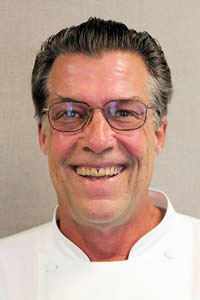
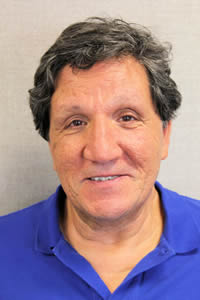
Our conversation with Frank bounced around from the rough go that is summertime for New Orleans restaurants, to the way that his style of cooking has moved from being thought of as cutting edge to traditional, while involving the same dishes. From the improved availability of locally-raised produce and fresh seafood, to why he left Charlie's Seafood behind. (Landlord issues.)
The most interesting story was one I'd heard before, but in more detail. Frank began cooking for a living at the extinct Ichabod's Galley, a small local chain that may have been the apotheosis of American casual dining in the early 1970s. (Salad bar, prime rib, glass-bottomed pewter beer tankards, the menu painted on the side of an empty Mateus bottle, etc.)
Then he decided to get serious, and applied for a job at Commander's Palace. Chef Paul Prudhomme headed the kitchen at that time. "He told me, 'You can either start on the broiler station, in which case I will ask you what you can do for me,'" Frank remembers. "'Or you can start back in the pantry. Then you can ask what I can do for you.'" What Chef Paul meant, and expressed many times thereafter (Frank took the second option), was that Frank had the opportunity to learn the big picture. Later, Chef Paul would ask, "Where do you see yourself headed?" This led to Frank's becoming Chef Paul's second in command when K-Paul's opened. And later, it led to Chef Paul telling him, "It's time for you to open your own place." Paul made it possible for Frank to make that jump.
"But on my final day at K-Paul's," Frank said, "he handed me a paycheck and said, 'This is the last one of these you're going to get! Don't forget that!'"
Meanwhile, Moncef Sbaa was making the rounds of the gourmet bistros and some major restaurants around town, running the dining rooms. One of those was Stephen & Martin, the first gourmet bistro in New Orleans, and one whose influence continues to this day, even though it's been closed for a couple of decades.
Moncef is from a town outside of Tunis, the capital of Tunisia. Tunisia has in addition to the rest of its long history (as the site of Carthage, it was already important in ancient Roman times) a substantial French heritage. This shows in the food of Jamila's. In addition to such North African classics as couscous, some dishes seem very French (notably "brik," a delicate en croute appetizer).
One of the reasons we asked Moncef to appear on the radio is that our Eat Club cruise next April will stop in Tunisia, en route to Sicily. I'm going to ask him to host our pre-cruise dinner, and tell us some things about his homeland. He's full of stories, given in an engaging, joyful style.
Frank Brigtsen was unaware of Jamila's, even though it's only five blocks from his own restaurant. (Not many restaurateurs dine out a lot.) He seemed to be intrigued enough to make plans to eat there soon with his exact-contemporary wife. (Frank and Marna were born on precisely the same day. A marriage made in heaven, by that and all other indications.)
I called my sister Lynn after the show for company at dinner. Lynn is a sushi lover, and I was thinking about one more visit to Chiba on Oak Street before writing a review tomorrow. Since the Marys don't do sushi, and Jude is here only rarely, it's good to have Lynn as a dining partner.
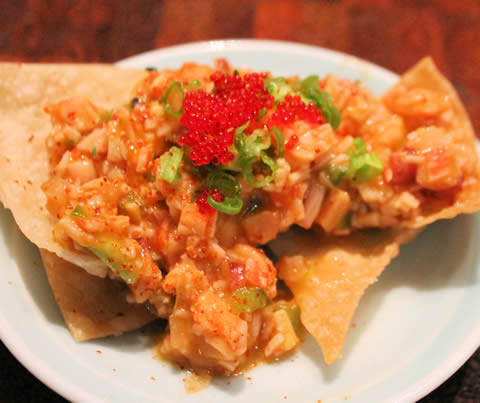
Chiba is trying to move to the next level in sushi non-cookery. It makes strong claims for the quality of its raw materials, and brings in certain fish I've never heard of before. Since one of my first questions at any sushi bar is, "What do you have that's different?" that is doing something. They have also gone a bit multi-national. Not just Pan-Asian (although there's a bit of that, most notably in the Thai-style lemongrass soup), but Latin American. Lots of ceviche, for example (see above). That's a trend that has been catching on in a lot of sushi bars, since it's another approach to raw or nearly-raw fish.
Chiba is messing around with tacos, too. We tried a couple of those, and concluded that either a) further research must be done or 2) the next idea should be invoked.
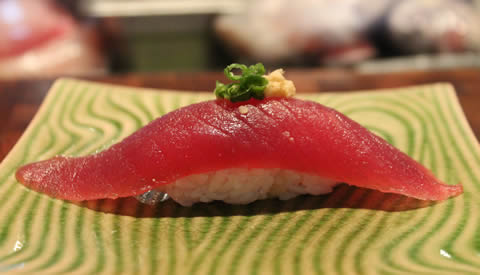
Even though we tried a lot of the above, the meal was memorable because of two extraordinarily fine items we ingested. First was a gorgeous slab of bonito. That's a member of the tuna family, resident in Gulf waters. But the only way you are likely to come into contact with bonito is through its dried flakes, which are used in the building of such things as soup and as a condiment on chirashi sushi. I will begin seeking this out in sushi bars as a regular nigiri sushi, and hope it's as fine as what we had tonight.
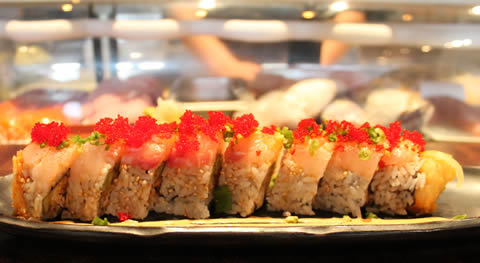
The other goodie was the Gulf Coast roll. Tempura red snapper in its center, a layer of rice around that, and a raw red snapper exterior. A topping of tobiko added the finishing touch. This was unique and outstanding.
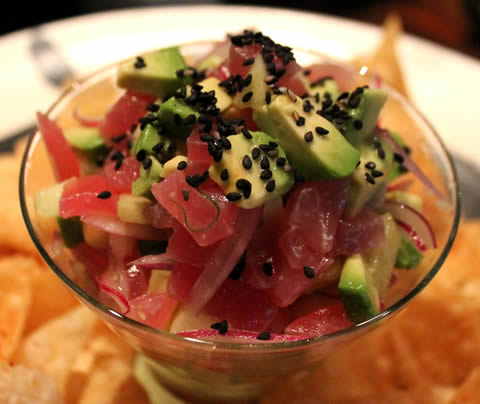
Also good here was a ceviche-style amuse bouche as big as a standard sushi serving. (Top photo in this section.) Later in the meal we enjoyed a very pretty tuna ceviche (just above). All came from an entirely western sushi chef who clearly knows his stuff.
I think Chiba might be busier were it not for a quirk in its service. When you order an individual sushi, you get one piece, not the usual two. The pieces are bigger than average, but when you do the math on the prices it comes out higher than one may be accustomed to.
They also have the most uncomfortable chairs of any New Orleans restaurant. The fact that they all look hand-crafted doesn't help that problem.
Chiba. Carrollton: 8312 Oak St. 504-826-9119.

To browse through all of the Dining Diaries since 2008, go here.